How We Borrowed an Idea From Amazon to Build Our Latest Product (With a Little Help From Otto's in Dover)
How Sean and I used a PR/FAQ, ChatGPT, a few trips to Otto’s, and some very tough questions from our advisors to turn an idea into the AB-09.
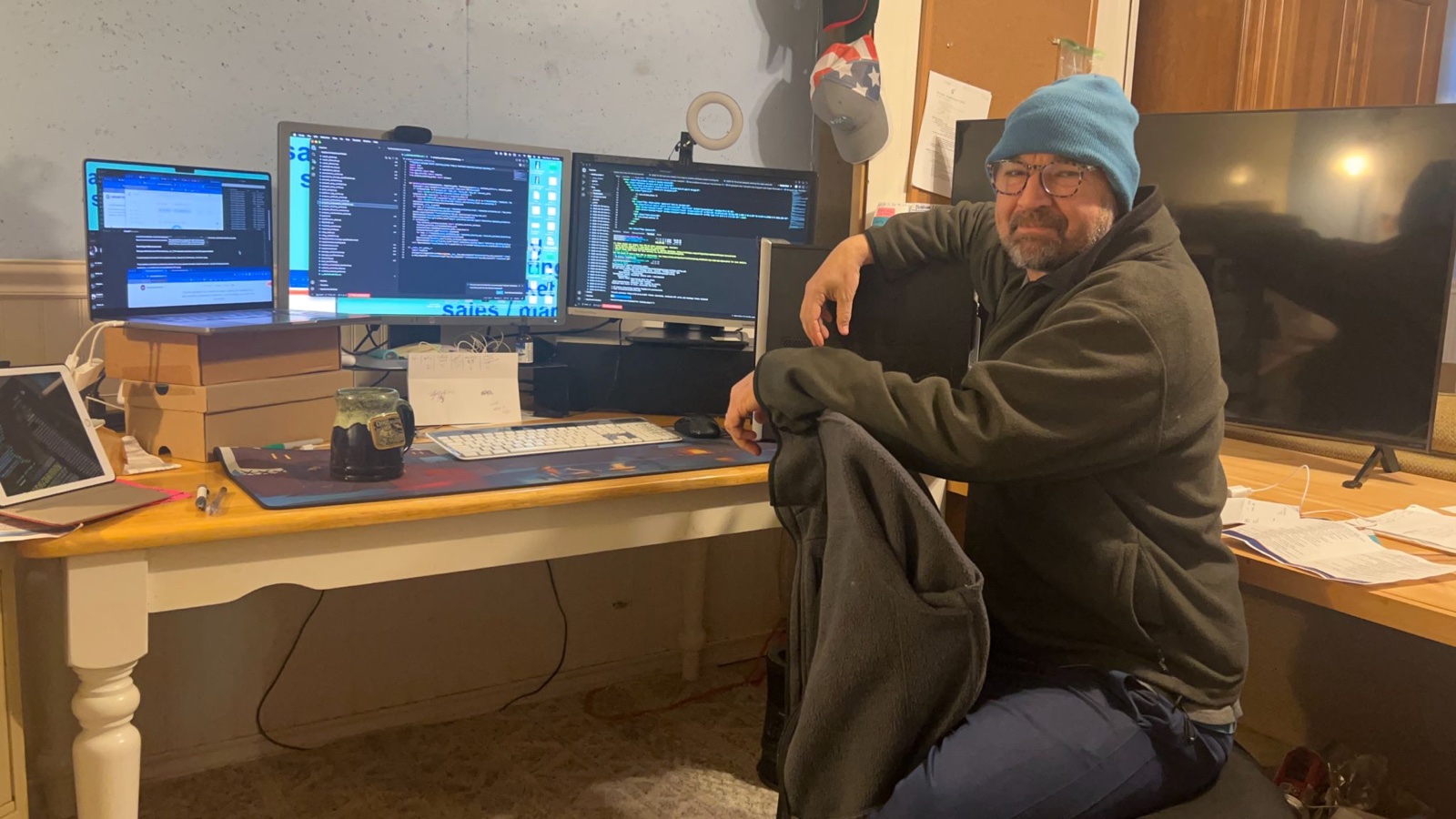
When Sean and I started working on what would eventually become our AB-09 Private Intelligence Appliance, the first prototype was built in my cold basement (our office is getting a bit crowded as we continue to grow). Yes, that image is really what the working conditions looked like. Don’t judge my fashion please! We had computers, code, a lot of ideas, and a pretty good sense of the problem we wanted to solve. What we didn’t have yet was a fully thought-out product and business plan.
Normally, as engineers, our instinct is to start building. Give us a technical problem and we’ll happily spend hours figuring out the hardware, software, network, and everything else needed to make it work. This time, though, we decided to try something different before getting too far into the engineering. We borrowed an approach from Amazon called PR/FAQ.
What is a PR/FAQ anyway?
For folks unfamiliar with it, PR/FAQ stands for Press Release and Frequently Asked Questions. It’s part of an approach Amazon calls working backwards. Instead of starting with the technology and trying to find customers for it, you start by imagining the finished product from the customer’s perspective.
You write a fictional press release announcing the product as if it’s available today. It needs to explain, in plain English, who it’s for, what problem it solves, why somebody would want it, and why it’s different from what they can already buy. Then you write the FAQ. That’s where you get into all the hard questions that a customer, advisor, or someone responsible for building and supporting the product is likely to ask.
It sounds simple, and the concept really is. The actual work is another story! When you have to describe a product clearly enough that somebody else can understand it, you quickly discover which parts of your idea are solid and which parts you’ve been filling in with assumptions.
I liked the approach immediately because Sean and I are engineers first. We tend to approach things logically and pragmatically. But just because we CAN build something doesn’t mean we SHOULD. And even when we know how to build it, that’s a very different question from whether somebody will pay for it, use it, and be happy with it after we’ve installed it.
Many hours with ChatGPT
I started working on the first PR/FAQ with ChatGPT. When I say working with it, I don’t mean typing “hey AI, write me a business plan” and getting a finished document five minutes later. It took many hours of back and forth, challenging assumptions, answering questions, rewriting sections, and sometimes realizing that we hadn’t actually answered the question we thought we’d answered.
One of the things I like about using AI this way is that it can be a pretty patient thinking partner. I could explain an idea, ask it to challenge the idea, decide I didn’t like the answer, and work through another version. Sometimes I’d agree with its criticism, sometimes I wouldn’t, but either way it forced me to explain what I was thinking. The document got better because of the conversation, not because ChatGPT magically knew how our business should work.
We kept coming back to the same practical questions. Who is really going to buy this? What would make them choose it over a cloud-based AI subscription? How will we install it and support it? What would a construction company actually do with it on day one? How would we explain the value to somebody who doesn’t care what model or hardware is inside the box? And, maybe the most important question of all, what problem are we really solving?
We weren’t just building an AI computer
One of the things we held onto strongly through the process was that we weren’t just building an AI computer. We were solving a problem we’d heard directly from MANY construction owners. They wanted to use AI with their own estimates, project records, financial information, and proprietary company knowledge, but they simply weren’t comfortable sending all of that to outside AI providers.
That distinction changed the way we talked about the product. The technology matters, of course. We still had to figure out how to make private AI useful, practical, and supportable in a real construction office. But the customer wasn’t asking us for another piece of hardware to manage. They wanted a way to use their own information with AI while keeping that processing inside their company.
Writing the fictional press release made us explain that in language a customer would care about. The FAQ then made us confront everything else. What does “private” actually mean in this installation? Does it need the internet? What kinds of documents can it work with? What happens when the answer is wrong? Who helps the employees learn to use it? What if the customer already has an IT company? Those aren’t questions you want to discover for the first time while standing in a customer’s office with a new appliance.
It also made us think about what we could reasonably promise. We weren’t going to claim that AI could automatically understand every file or replace an estimator’s judgment. We wanted the product to be genuinely useful, but we also wanted to be able to stand behind what we told people.
Then we took the document to Otto’s
Once we had a draft we felt pretty good about, Sean and I did what we usually do. We walked it over to Otto’s in downtown Dover and went through it together. I’ve personally discovered that some of our best thinking happens over a couple of drinks at Otto’s, which is much easier for me now that my kids are all grown up! I’m pretty sure this qualifies as a legitimate engineering methodology or something.
There’s something useful about getting away from the monitors and talking through an idea face to face. We could work through what made sense, what didn’t, and which questions we were still avoiding. A sentence that looks perfectly reasonable in a document can sound a little ridiculous when you have to explain it to another engineer sitting across the table.
And because we had the PR/FAQ in front of us, the conversation stayed grounded. We weren’t just talking about some future private AI box in general terms. We were talking about the specific product we were proposing, the customer we wanted to help, the promises we were making, and how the whole thing would actually work.
Our advisors got their turn (sadly, not at the bar)
Next, we presented it to our advisors. Unfortunately, they prefer a Zoom call to an in-bar meeting. I still think there’s room for improvement in that process!
They challenged us on pricing, support, competition, and whether customers would actually pay for it. They asked the kinds of questions that are easy to overlook when you’re excited about an idea and have already started picturing how to build it. We wanted those questions, even when they were uncomfortable. Totally worth every second of the abuse.
This was probably one of the biggest benefits of having written the PR/FAQ first. Everyone had the same document. If an advisor questioned the business model or a product promise, we could discuss that specific assumption and change it. We weren’t trying to debate five different imaginary versions of the product. We had something concrete to challenge, improve, and bring back for another look.
I think that’s an underrated part of the process. A good review isn’t a meeting where everyone says they love the idea. It’s a meeting where the difficult questions come out while you’re still able to make changes without tearing apart months of engineering work.
What the process actually gave us
By the end, we had more than a nicely written document. We had a much clearer understanding of the customer problem, how we wanted to position the product, what needed to be included in an installation, and what we still needed to prove. We had thought through the difference between selling an appliance on its own and including it in a broader technology partnership. We’d discussed training, support, and the practical realities of making something work inside another company’s network.
Just as important, Sean and I had a shared picture of what we were trying to build. That matters when you’re a small company doing a lot of things at once. It’s pretty easy for two technical people to agree that an idea sounds good while quietly imagining different versions of it. A written PR/FAQ gives you something to point to when you’re deciding what belongs in the product and what can wait.
The process didn’t remove uncertainty. It didn’t guarantee that the product would sell, and it certainly didn’t mean every technical question had been answered. What it did was make the unknowns more visible. That’s a pretty big win when you’re deciding where to invest your time and money.
From a cold basement to paying customers
Fast forward to today, and the AB-09 Private Intelligence Appliance is a real product with several paying customers. And one of the most rewarding things has been seeing how it has allowed our customers to get REALLY creative with their thinking about what they can do with their own information.
That’s the part I keep coming back to. We started with a problem we heard from construction owners, spent a lot of time making sure we understood it, challenged the proposed solution from several directions, and then built something people are actually willing to pay for. There’s still plenty of work ahead of us, but it’s pretty exciting to see the idea become real.
Looking back, I think the PR/FAQ was especially valuable because it made us think through the business before getting too far into the engineering. Not instead of engineering. We still love that part! But it helped us focus the engineering on a product with a clear purpose and a real customer problem behind it.
I think we’ll definitely use this approach again at AutomateBetter. It fits the way we like to work: logically, pragmatically, and with enough room for other people to tell us where our thinking might be wrong.
And I’m pretty sure we’ll keep holding some of those review meetings at Otto’s. After all, you don’t want to mess with a process that’s working! 🍻🍻🍻
Want to explore private AI for your construction company? Contact us to talk about the AB-09 and your team’s needs.