
What Should a Contractor Automate First?
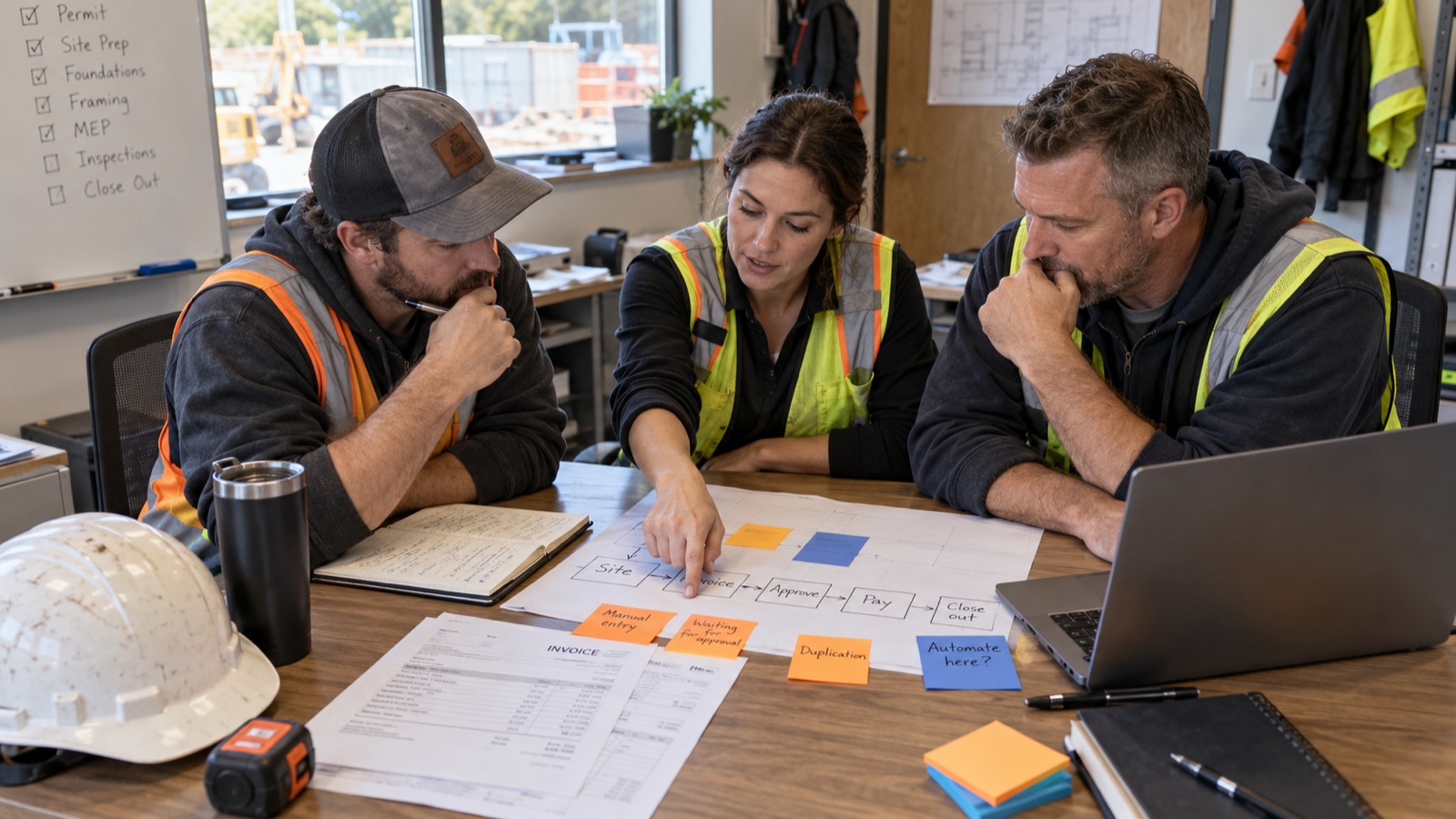
An estimator wants less duplicate entry. Accounting wants complete invoice information. A superintendent wants to stop writing the same update in three places. Leadership wants a reliable view of all of it.
Each request can be reasonable. The first decision is which improvement will matter enough, and has enough of its dependencies in place, to be worth doing now.
Follow one real piece of work
Choose a recent invoice, field report, estimate, or change request. Walk it from its arrival to its completion with the people who actually handled it. Record where information was entered, checked, corrected, or chased.
Ask what happened when something was missing. The exception often explains more than the happy path. A process that looks like a simple approval may depend on a project manager finding a cost code, a foreman confirming delivery, and an administrator interpreting an email.
Compare opportunities using the same questions
For each candidate, consider:
- Value: What operating decision or result would improve?
- Frequency: How often does this work happen, including the exceptions?
- Risk: What would a wrong result cost, and who needs to review it?
- Effort: Which steps can be changed without disrupting the rest of the business?
- Dependencies: Are the records, access, and process owners available?
- Confidence: What evidence supports the proposed approach?
Keep the assumptions visible. A large estimated saving based on an untested guess should not automatically outrank a smaller improvement supported by actual records.
Give the first implementation a finish line
A hypothetical invoice project might start with one business unit and a defined set of vendors. The first version could capture the invoice, check for required information, and route exceptions to an owner. Posting to the ERP could follow once coding and approval rules have been validated.
That is a useful boundary because the team can evaluate the result. It also makes the missing dependencies visible before expanding the work.
Agree a baseline and a review point. Measure the time spent handling comparable invoices, the exceptions that still require attention, and whether the people doing the work find the result useful. An automation being switched on is a delivery milestone. The operating result is what tells you whether to expand it.
Start with the company, then choose the workflow
The Construction Intelligence Sprint uses EverySeat to gather perspectives across field, office, and leadership before ranking opportunities. It includes a first implementation or meaningful prototype and a 12-month roadmap.
Bring one workflow that keeps coming back to your desk to a 20-minute discovery conversation. We can discuss what would make it a useful starting point.
Keep exploring
Read our answer on choosing the first automation for the practical next steps and related workflows.
The Lean Construction Institute explains how handoffs and waiting affect workflow, a useful companion to tracing the work before automating it. See its Focus on Flow guide.